One More Game: The Hidden Ways Pool Halls Empty Your Pockets Before You Notice

The Meter's Running Before You Even Break
You walked in with forty bucks and a plan to play for an hour. Three hours later, you're splitting a pitcher, you've got another thirty minutes on the table, and someone just suggested a friendly little side bet to make the last rack interesting. The forty dollars is a memory.
This isn't bad luck. It's not even poor discipline, exactly. It's the architecture of the place working exactly the way it was designed to work—and if you've never stopped to think about it, you're probably handing over more money than you realize every single time you show up.
Pool halls are one of the most psychologically effective environments for encouraging continued spending that American entertainment culture has ever produced. That's not a knock on the venues—it's just the honest truth. Understanding why it works so well is the first step toward actually being in control of your night instead of just surviving it.
The Time-Blind Problem
Table fees are almost always charged by the hour, sometimes by the half-hour. That sounds simple enough. The problem is that pool completely destroys your sense of time.
When you're locked into a rack, tracking position, adjusting your stance, debating whether to play safe or go for the combo—you are not thinking about the clock. The cognitive load of the game is high enough that external time cues just fade out. You're not checking your phone. You're not watching the door. You're watching the cue ball.
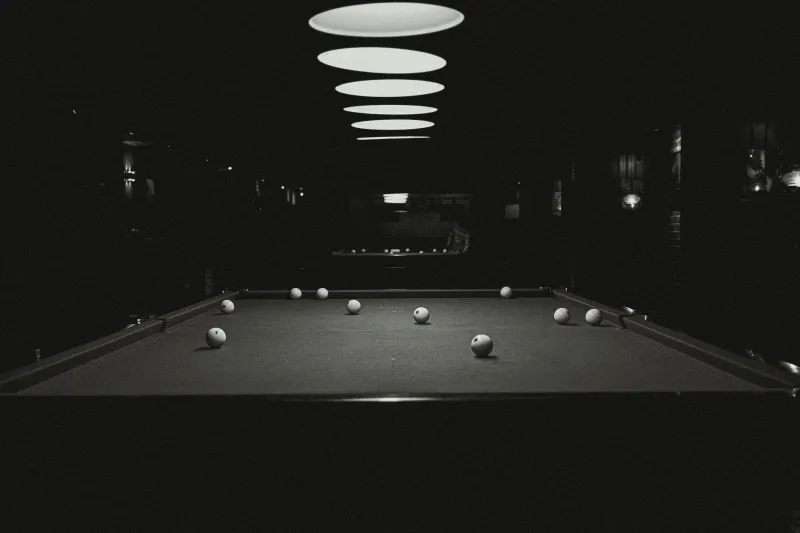
Pool hall operators know this. It's why the lighting is almost always dim and warm. It's why there are rarely windows. It's why the music sits at a volume that fills the room without demanding attention. The environment is calibrated to keep you present at the table and unaware of how long you've been there.
By the time you resurface and check the time, you've already committed to another thirty-minute block. Might as well finish it out.
The Social Spending Spiral
Here's the one that really gets people: the pressure to keep pace with the room.
Pool is a social game. You're rarely playing in a vacuum. You're playing with friends, against strangers, or in the orbit of a whole hall full of people who are all doing the same thing. And when you're in a social environment, spending becomes contagious.
Somebody orders a round. You're in. Somebody suggests bumping up the stakes on the next game. You don't want to be the one who backs down. Somebody's been feeding quarters into the jukebox and expects the same from everyone at the table. You dig in your pocket.
None of these individual decisions feels significant. A drink here, a small bet there, a couple bucks for the next hour of table time—these are all low-stakes choices in isolation. But they compound fast, and they compound in an environment where you're relaxed, a little competitive, and surrounded by people who are all doing the same thing. The social permission structure makes spending feel normal, even obvious.
This is categorically different from compulsive behavior, but it produces similar results: you spend more than you intended, and you didn't really notice it happening.
The Bet That Made Sense at the Time
Side bets deserve their own section because they operate on a completely different psychological track than everything else.
When you're gambling on a game—even small amounts—your brain shifts into a different mode. The stakes change what the game means, which changes how you feel about each shot, which changes how you feel about the outcome. Winning a five-dollar bet feels disproportionately good. Losing one feels disproportionately bad.
That imbalance is exactly what drives the "one more game" impulse. You're not chasing money. You're chasing the feeling of being square, of having the last result reflect your actual ability, of not walking out on a loss. The math on getting that feeling back is always worse than it looks in the moment, but the math isn't what you're running when you're standing at the table with a cue in your hand and something to prove.
Calculated risk means you set a number before you start—a hard ceiling on what you're willing to lose in a session—and you treat that number like a bill, not a suggestion. Compulsive spending at the table looks exactly like calculated risk from the inside, right up until the moment it doesn't.
Playing Up vs. Playing Smart
One of the more expensive habits in any pool hall is consistently playing against people who are significantly better than you.
This sounds counterintuitive. Playing tougher competition makes you better, right? Sure, eventually. But if you're regularly putting money on games against players who outclass you, you're paying tuition at a rate that adds up fast—and the lessons don't come with a syllabus.
There's a real difference between challenging yourself and repeatedly funding someone else's night. Better players know this. They're not being predatory, necessarily—they just understand the value of their time and skill at the table. If you're consistently on the wrong end of that equation, the issue isn't that you're getting hustled. The issue is that you haven't been honest with yourself about where you actually are as a player.
Playing up is fine. Paying to play up without a clear sense of what you're getting out of it is where the money disappears without a return.
Building a Budget That Actually Holds
None of this means you should stop going to the pool hall. That would be a ridiculous conclusion. The point is to go with your eyes open and your wallet a little better defended.
A few things that actually work:
Set a hard number before you walk in. Not a range—a number. That's your ceiling for the night, covering table time, drinks, and any action you decide to take. When it's gone, it's gone.
Use a timer on your phone. It sounds dorky, but setting a fifteen-minute warning before your table time runs out keeps you from sleepwalking into another hour.
Separate your game money from your action money. If you're going to bet on games, keep that cash physically separate from what you're using for everything else. When the action money is gone, you're done betting—full stop.
Know your level and play it. There's no shame in playing people at your skill range. You'll get more competitive games, spend less, and have more fun.
The Felt Doesn't Judge, But Your Bank Account Does
Pool halls are genuinely great places. The culture is real, the games are legitimately fun, and the social experience is hard to replicate anywhere else. But they're also environments where money moves easily, quickly, and in ways that aren't always obvious until after the fact.
The players who get the most out of the hall—the ones who show up consistently, stay sharp, and never leave feeling burned—are the ones who treat their spending like part of the game. They're not tighter than everyone else. They're just paying attention to a table that most people forget is even running.
Rack 'em up. Just know what it's costing you.