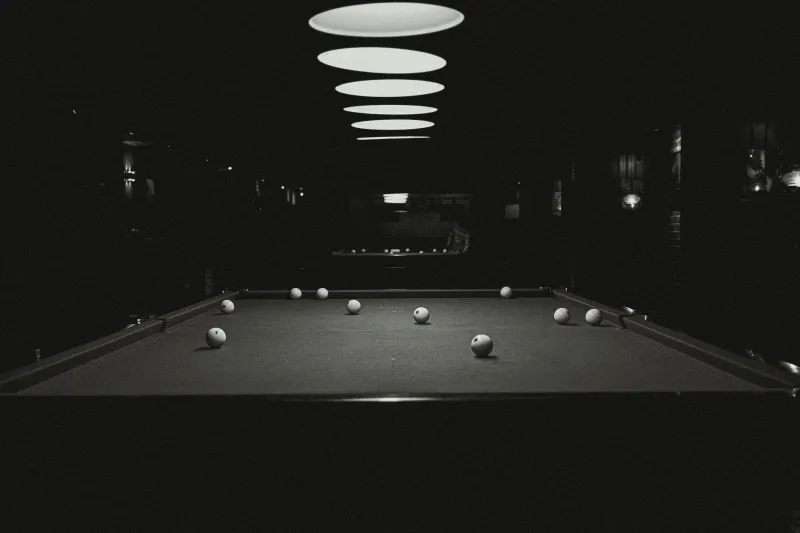
This Table's Taken: The Quiet Power Moves That Define a Pool Hall Regular

Walk into any pool hall on a Tuesday night around 7 p.m. and you'll notice something that doesn't quite make sense at first. Tables sit open. Chairs are empty. The place isn't packed. And yet, somehow, a guy in a faded Carhartt jacket is standing right next to table seven looking like he's waiting for a bus that only he can see. He's not on his phone. He's not eating. He's just... there.
That's not random. That's territory.
Pool halls run on an invisible social architecture that nobody writes down and nobody officially teaches. But every regular knows it cold. Every newcomer eventually figures it out — either by reading the room carefully or by making one awkward mistake that earns them a look they won't forget. Understanding how this territorial system works isn't just useful. It's the difference between fitting in and feeling like a trespasser in your own favorite bar.
The Map Nobody Posts on the Wall
Every pool hall has geography. Not just physical layout — actual social geography. Table one near the front might be where the casual drinkers drift when they want to knock balls around between rounds. Tables in the back corner are where the serious players go. The table closest to the bar is the social table, always rotating, always loud. The table farthest from the jukebox is where someone who actually wants to practice their cut shots sets up camp.
Regulars didn't invent these zones intentionally. They developed organically over weeks and months of the same people showing up at the same times and gravitating toward the same spots. Over time, patterns calcified into something that feels almost like assigned seating — even though no one ever assigned anything.
The Carhartt jacket guy? He's been coming to table seven on Tuesday nights for two years. He doesn't own that table. His name isn't on a lease. But everyone in that room knows it's his table on Tuesdays, and standing next to it while he grabs a drink from the bar is just him holding his spot the way anyone would save a seat at a movie theater.
How Territory Gets Claimed Without a Word
The mechanics of space-claiming in a pool hall are subtle and almost entirely nonverbal. A cue case leaned against the rail. A jacket draped over the scoring unit. A chalk block sitting on the corner cushion. These aren't accidents. They're flags — quiet signals that say this space is occupied without requiring anyone to actually say it out loud.
Regulars also claim through timing. Showing up at the same time every week, playing on the same table, establishing a rhythm — that's how you build a soft claim on a spot. The staff learns it. The other regulars learn it. Eventually, even the bartender knows that if someone's sitting on a stool near table four at 8 p.m. on a Thursday, they're probably waiting for their regular partner to show up.
None of this is confrontational. That's the whole point. The best territorial moves in a pool hall happen so quietly that new players don't even realize they're watching a system operate.
The Hierarchy Is Real, But It's Not Ruthless
Pool hall social structure tends to organize around a few key factors: how long you've been coming, how well you play, and how well you treat people. Skill alone doesn't automatically earn you status — plenty of excellent players walk into a new room and still have to pay their dues. But skill combined with consistency and respect? That builds reputation fast.
At the top of the informal hierarchy are the lifers. These are the people who've been regulars for years, who know the owner by first name, who can tell you what the house cues were like before they replaced them in 2019. They don't usually enforce anything directly. They don't have to. Their presence alone communicates authority.
Below them are the solid regulars — people who show up weekly, have their preferred tables, maybe run a few leagues out of the place. These are the folks who'll give a newcomer a genuine heads-up if they're unknowingly stepping into someone's spot. Not rude about it. Just informative.
Then there are the newer players working their way in. They're learning the map in real time, sometimes making small missteps, gradually earning their own place in the rotation.
What Happens When Someone Steps on the Wrong Toes
Conflict in a pool hall over territory is usually quiet and rarely escalates into anything dramatic — at least in places with a decent culture. Someone might get a look. A regular might say something dry and understated. The vibe might shift just enough for a perceptive person to notice.
Actual blowups over table space are rare and almost always involve a combination of alcohol, an already tense situation, and someone who clearly doesn't understand or doesn't care about the room's social contract. Those situations are about more than a table. The table is just where it lands.
For the most part, when a newcomer unknowingly takes a regular's preferred table, the regular either waits it out, moves to another table without making a scene, or — if they're the kind of person who handles things well — just introduces themselves and strikes up a conversation. That's actually how a lot of pool hall friendships start.
How to Earn Your Spot Without Making Enemies
If you're new to a pool hall and want to find your footing without accidentally stepping on anyone, the approach is pretty straightforward.
Show up consistently. Coming in once is being a customer. Coming in every week is becoming a regular. Regulars earn their spots through presence, not proclamation.
Read before you park. If a table has anything on it — a cue case, a jacket, a drink, a chalk — assume it's occupied. Ask the bartender or staff which tables are available. They always know.
Be cool when you're wrong. If you accidentally take someone's usual spot and they show up, just be easy about it. Offer to move. Most regulars will tell you to stay put and find another table themselves. A gracious response in that moment goes a long way.
Don't rush to claim. Let your habits build naturally. Come in, play your game, be respectful of the space. After a few months of consistent visits, you'll find you've organically landed in a spot that feels like yours — because it kind of is by then.
The Bandit in All of Us
There's something almost romantic about the way pool hall regulars claim their territory. It's not aggressive. It's not petty. It's human — the same impulse that makes someone sit in the same pew every Sunday or order the same thing at a diner they've been going to for years. People find their spots, and those spots start to feel like home.
A good pool hall knows how to honor that without letting it calcify into something exclusionary. The best rooms in the country have regulars who've been coming for decades and newcomers who feel welcome from their first night. That balance isn't an accident. It's culture, built one Tuesday night at a time.
So if you're new to the game or new to a room, don't be intimidated by the invisible map. Just pay attention, be respectful, and show up. Your table is out there. You just have to earn it.