Velocity, Angles, and Felt: What Physics Actually Does When You Break
Watch a professional break shot in slow motion and something strange happens — what looks like raw, violent power suddenly reveals itself as something almost delicate. The cue tip makes contact for less than a millisecond. The cue ball compresses, ever so slightly, before releasing all that stored energy into the rack. The lead ball doesn't just get hit. It becomes a messenger, passing force through a tightly packed geometry of fifteen balls in a cascade that's been described by physicists as one of the most complex collision events in recreational sport.
None of that is visible to the naked eye at the table. But it's all happening, every single time someone steps up to break.
It's Not About How Hard You Hit It
This is the first thing coaches will tell you, and the first thing most casual players refuse to believe. Raw strength contributes to a good break, sure — but it's not the engine. Cue ball speed at the moment of impact is what actually matters, and speed is a product of technique, not muscle.
Billiards coaches often describe it in terms of "effective velocity" — the speed the cue ball is actually traveling when it reaches the rack, not the speed it left your cue tip. Friction from the felt, the arc of your stroke, and the point of contact on the cue ball all bleed off energy before the ball gets where it's going. A player who swings hard with a tense arm and a jabbing stroke might generate less effective velocity than someone with a looser, longer, more fluid delivery.
The goal is to transfer as much kinetic energy as possible from the cue to the cue ball, and then from the cue ball into the one-ball at the apex of the rack. Every inefficiency in your body mechanics is energy that never makes it to the rack.
Bridge Stability Is Doing More Work Than You Think
Here's something that doesn't come up enough in break-shot conversations: the bridge hand. Not the stroking hand, not the grip — the hand that's holding the cue steady against the table.
When you break, you're generating significant force. If your bridge is unstable — too high off the felt, fingers loose, wrist cocked at an odd angle — the cue itself can deflect slightly at the moment of contact. We're talking about fractions of a millimeter. But at the speeds involved in a break shot, fractions of a millimeter in cue deflection can translate to meaningful changes in where the cue ball actually strikes the rack.
A low, locked bridge keeps the cue on its intended path through the contact zone. Coaches who work with serious players often spend as much time on bridge mechanics as they do on stroke mechanics, precisely because the bridge is where a lot of break-shot inconsistency originates.
The Rack Geometry Problem
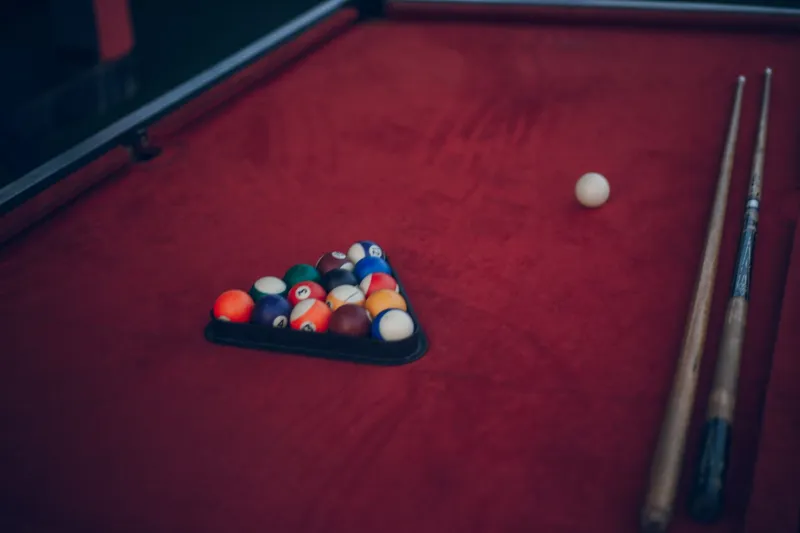
Even if you execute a mechanically perfect break, the rack itself introduces a layer of physics that's partly outside your control. The tighter the rack — balls touching, no gaps — the more efficiently energy transfers through the formation. A loosely racked set of balls absorbs energy at every gap, and the scatter pattern becomes less predictable.
This is why professional players (and serious amateur players) often take time to inspect and sometimes re-rack before a break. It's not fussiness. It's physics. A gap between the one-ball and the two-ball is essentially a buffer zone that eats kinetic energy before it can reach the back row.
The angle at which the cue ball contacts the one-ball also shapes the entire scatter pattern. Even a one-degree deviation from center contact changes which balls go where. In nine-ball especially, where the break can decide the entire game, players spend serious time developing a repeatable, centered contact point on the lead ball.
Cue Equipment and the Science of the Tip
The cue tip is the only part of your equipment that actually touches the ball, which makes it disproportionately important. Tip hardness affects how long the tip stays in contact with the cue ball during impact — a measurement called "dwell time." Harder tips have shorter dwell times, which means less opportunity for the tip to slide off-center. Softer tips grip the ball slightly longer, which can help apply spin but also introduces more variables on a power shot.
Many players who break with a dedicated break cue use a harder tip for exactly this reason — they want consistent, centered contact with minimal spin-related deflection. The cue shaft itself matters too. Low-deflection shafts, which have become increasingly common at the competitive level, reduce the degree to which the cue ball veers off its intended path when struck slightly off-center.
Break cues are also typically heavier than playing cues, adding mass to the equation. More mass at the same velocity means more momentum transferred to the cue ball — basic physics, but it adds up.
What Slow-Motion Analysis Actually Reveals
High-speed camera footage of professional break shots — the kind shot at thousands of frames per second — has genuinely changed how coaches understand the shot. What looks like a single explosive moment is actually a sequence of distinct events: cue tip contact, cue ball compression, energy release, one-ball displacement, and rack scatter, all unfolding in a chain that takes less than a tenth of a second from start to finish.
What the footage consistently shows is that the players with the most devastating breaks aren't necessarily swinging the hardest. They're the ones whose cue stays on the same plane through the entire stroke, whose bridge doesn't flex at contact, and whose cue ball arrives at the rack on a precise, repeatable trajectory. The violence is controlled. The power is directed.
Bringing It Back to Your Game
You don't need a physics degree to improve your break. But understanding even a little of what's happening under the surface changes how you practice it. Instead of just hitting harder, you start thinking about your bridge. Instead of just aiming at the rack, you start thinking about where exactly on the one-ball you're making contact.
The break is the one shot in pool where you have complete control over the setup. No opponent has positioned the balls. The rack is where you put it, the cue ball is where you place it, and the stroke is entirely yours. The physics doesn't care how strong you are. It rewards precision, consistency, and an understanding of how energy wants to move.
Rack 'em up. And next time you step up to break, know that you're not just hitting a ball. You're setting a chain of physics in motion.